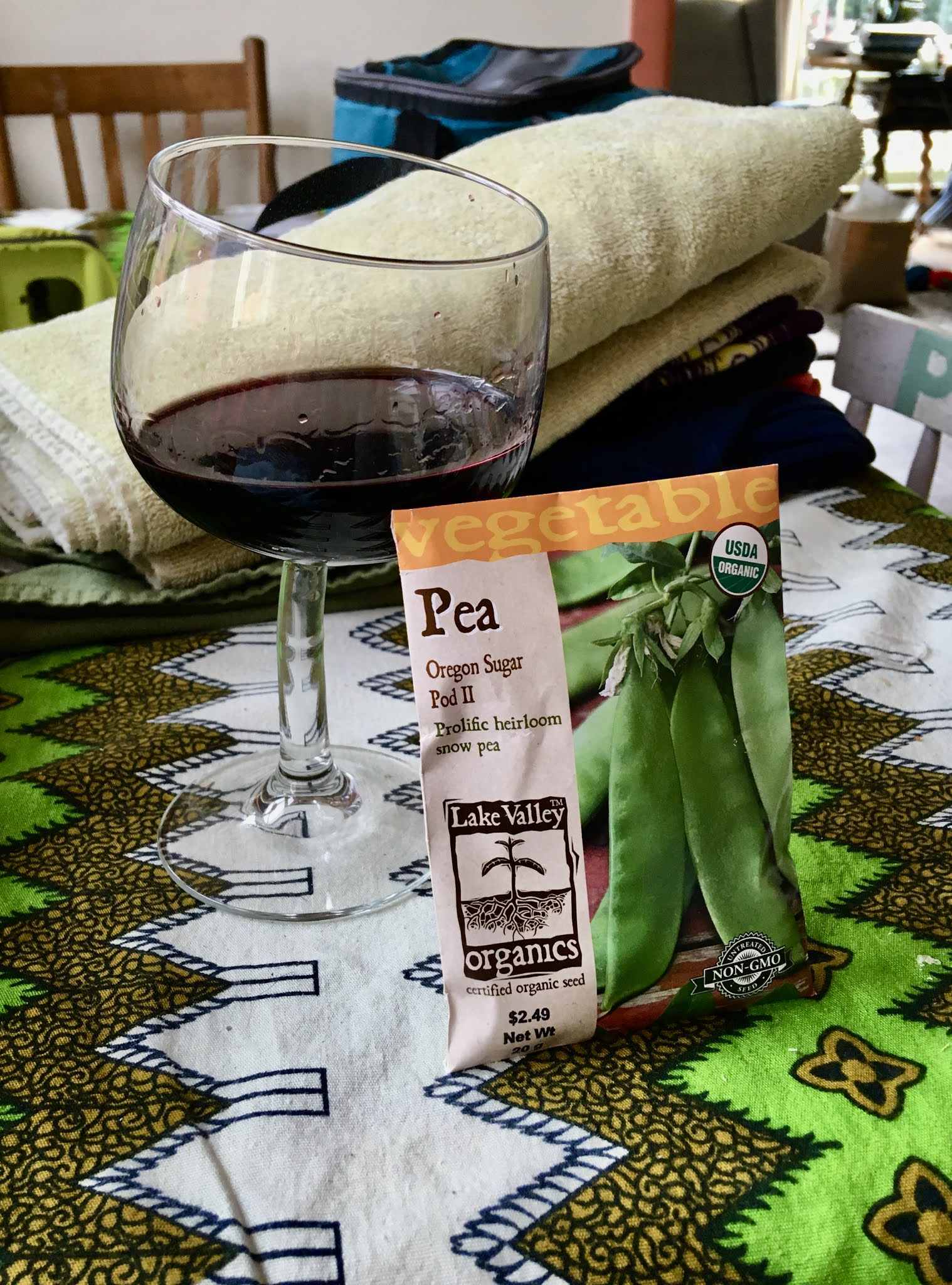
 Pea Planting Day is a special anniversary for us. February 22 is listed on my planting calendar as the first day to plant peas in the Willamette Valley; it also happens that this is the day W and I got engaged to each other, 50 years ago!
Peas are traditionally the first vegetable sown outside in the spring because they will germinate and grow in very cool soil. We plant peas today to ceremonially kick off the start of the planting season, and also to remind ourselves of the beginnings of our relationship; the day we decided to be together forever.
Forgiveness Sunday is an Eastern Orthodox holiday that marks the start of Lent. The Western and Eastern churches usually celebrate Lent and Easter on different dates - the Western dates are calculated with the Gregorian calendar, and the Eastern dates use the Julian Calendar.

Agenda:
1. Devotions
2. Beingness
3. Earth Action
4. Read "Revolutionary Witchcraft"
5. Ask forgiveness and offer forgiveness
6. Pea planting ceremony
7. Permaculture pea tips
8. Light a candle
1. Devotions:

Today Living Earth talks about baking bread and the history of the grains, the farmers, the rains, and how bread connects us to the world.
Earth Medicine speaks of the difference between being watchful and aware (in stillness) of changes in the weather, of fire, and of predators for survival, and the fearful anxiety that engulfs the human mind, that feeds "ignorance of the true connection to the Oneness found in the Great Mystery's healing and love."
2. Beingness:
For Lent I am finding creative ways to make space for Being in Nature.Today: Take time to reverently put the first seeds in the soil, and say a prayer toMother Earth.
3. Earth Action:
Each day I am taking an action for the Earth - Today I will make an Earth Care report to business meeting.
4. Read "Revolutionary Witchcraft":

Chapter 2 is Shaking Off the Dirt, about letting go of lethargy so we can change the world.
The first section is A Disenchanted World - "...a place of separation - from each other, the land, nature, our bodies... It's a place where all the magic is gone, and it's our job as witches to bring it back."
I just heard Nia Goes There say basically the same things: Someone is making a lot of money in the capitalist society, but it isn't us. We are cutting down forests, poisoning waters, and causing animals to go extinct in the service of making a profit for the billionaires. This whole system is bad news.
The second section is on Initiation, "any ritual or event that sort of breaks open your brain ..." She compares it to Wokeness, when you have a moment that shakes you up so you see things in a different perspective, and are never the same again. I've certainly had some of those moments. Initiation can happen spontaneously - She mentions the 2016 election as an initiation, "a night that will live in infamy."
Initiation "is like falling in love.You just know it when it happens - and it's big, scary, amazing, and life-changing."
The event I am thinking about happened during Covid, when we all had a lot of time to watch the world. I'm in my bubble, and see the videos of George Floyd being murdered; the shift in my mind was to wake up to a deep awareness of the violence all African Americans face all the time. That has been life-changing in a way that is hard to explain. But an earlier event that is similar is when I first read about real live Native Americans, and realized the myths I'd been taught all my young life - I think I was about 12, and I've carried a lot of grief and shame ever since.
She says "I knew in my head that things were bad, but until that day I didn't feel in my body or heart the layers of oppression, state control, and, to be frank, evil, that so many of us live under." This year I think many white people are finally being woken up to this reality.
"It's important to lean in to initiation and let yourself be changed by it. ... It's also important to remember that being initiated isn't the end of your journey, it's the beginning."
5. Ask forgiveness and offer forgiveness:
The traditional theme of the Lenten fast is repentance and reconciliation with God. The Eastern Orthodox Church reminds us that we can't have that without first being reconciled with one another. On Forgiveness Sunday they have a special Forgiveness Vespers, and at the end everyone takes part in the Ceremony of Mutual Forgiveness-- each person will bow down, first before the priest, and then each other, asking, “Forgive me, a sinner” and the proper response is “God forgives you”.
Each person asks forgiveness from, and offers forgiveness to, each other person, then exchanges the kiss of peace. Quakers don't usually go in for any kind of ceremony, but I can imagine that it's a powerful moment. Wesley J. Smith says "The service is a healing balm. It is hard to bear grudges when all have shared such an intimate mutual humbling. Indeed, Forgiveness Vespers is emotionally intense, tears often flow and hugs of true reconciliation are common."
As a Quaker, I have had to figure out simple ways to ask for and offer forgiveness and feel that humbling moment, and I do it as often as I can, with honest words, a note, or a silent prayer. A wise man said to forgive our neighbors even when they sin against us repeatedly, even until seventy times seven (Matthew 18:21-22). So, today I offer this prayer:
I offer forgiveness to those in my community who have wronged me this year, and ask forgiveness for those I have wronged. I pray that we can start fresh, with open hearts.In offering forgiveness, I hope to be able to set down this burden of indignation and rage, and move on to mitigating the problems we have created.
6. Pea Planting Ceremony:
Planting is such a basic act of life, and we will plant maybe a hundred seeds this year. Today we plant the first seeds - a few peas - with attention, and we plant together. We plant peas as an offering to the earth, and an offering to our relationship.
We also drink a little wine, and spill some on the ground, to bless the soil.
We also drink a little wine, and spill some on the ground, to bless the soil.
7. Permaculture pea tips:
 These tips help to make pea growing more efficient, and make use of the whole plant:
- Soak the seed: Last night I put a few peas (for planting today) into a bowl with some warm water.
- Staggered planting: I'll sow peas every 3 weeks, so I get a harvest over a longer period (starting now and ending mid-April).
- When harvest starts, I'll pick every other day and freeze any I don't eat: Peas are easy; just bag them and put them in the freezer as soon after picking as possible. There is no need to blanch.
- Succession planting: When the first plants begin to slow down, I will snip them at the base (leaving the nitrogen in the ground) and slip in a spinach plant or two.
- Mulch: I don't like to put pea vines into the compost because they are stringy, so I chop them up with a lopper and spread them around as mulch.
- Save seeds: And finally, I will save a few pea pods that have started to turn brown and just leave the seeds in the pods until fall planting time - early August.
8. Light a candle:
 |
| 2017 Maslenitsa Fire |
When I have this fire with children, we talk about the symbolism of burning away the winter so that spring can return. And because most of us have a primitive love of burning things, it takes only a minute for my students to be gleefully on board. We march together out to the fire circle, say a few words of thanks, stick the doll into the ground and watch it burn.
We won't burn our little cloth dolls this year, but I will take a moment to light a candle and say goodbye again to winter.


No comments:
Post a Comment