Showing posts with label earth stewardship. Show all posts

September 5, 2025

Habitat Haven

I had a visit from a botanist from Habitat Haven early this month, who sent me a report, and 6 certification objectives, which I will list here-

Agenda:
1. Remove invasive and nuisance weeds
2. Plan new naturescaping
3. Wildlife stewardship plans
4. Stormwater management
5. Pesticides reduction
6. Education & Volunteerism

February 14, 2024

Ash Wednesday and Valentine's Day!

Ash Wednesday is the first day of Lent, a 46-day period of preparation for the joyful Easter celebration. The word lent comes from the Anglo Saxon word lencten, which means "lengthen"; it refers to the longer days of spring. 

Lent is about mortality and transformation; death and rebirth. Marcus Borg says, "It means dying to an old way of being, and being born into a new way of being, a way of being centered once again in God."

Quakers don't traditionally celebrate Lent because we live every day being born again, centered in God. Still - I will always jump at a chance for a period of reflection.

Today is also Valentine's Day! Saint Valentine was a third-century Roman Christian who died on February 14. The poet Geoffrey Chaucer and his circle probably invented many of the romantic legends about Saint Valentine, in the fourteenth century.
Valentine made by a student of mine.
After that, it became a custom for a man to write a romantic poem to send to his beloved on St. Valentine's Day. Very fancy paper cards, with lace and ribbons, became popular in the 1840's, and that custom expanded into sending cards to Mom and Dad, and friends of all kinds.

Agenda:
1. Read "Lessons for Simple Living"
2. Simple Steps for this week
3. Make Valentines
4. Begin fasting
5. Hang up the Lent Lady

December 4, 2023

Advent Earth Care

My theme for this first week of Advent is "Cherish and care for the earth". I express my unity with nature at Advent in two main ways:

  • by offering small gifts of love and attention in recognition of all I receive from the earth
  • and by finding joy and fulfillment in simply being alive, instead of in an excess of buying, eating, using, and wasting.
Agenda Today:
1. Journal queries
2. Define my work for earth care
3. Make bird feeder pine cones

July 12, 2023

Make My Dreams Reality

I have a dream of a world where people are an integral part of nature and we show our love and respect with our actions every day; a world where people have a growing awareness of how to change our habits to care for the earth, and a growing and expanding love, to shift us all towards life.
I read the phrase "transformative eco-justice" on a webpage a few months ago, and it has been hanging in my heart: My dream is to live that transformation, and teach about it. 

Agenda:
1. Read "How to Manifest"
2. Write an invocation
3. Starting

June 6, 2023

The June garden

The June garden is pure abundance. It's too late to plant most summer veggies now in my valley, and too early to start fall crops, so my focus is on garden care - watering, weeding, mulching - and on HARVEST.

We have kale, lettuce, parsley, rhubarb, bok choy, and soon we will also have peas, raspberries, and strawberries to harvest. 

Agenda:
1. June permaculture plan
2. June planting tips
3. Squash bugs

May 14, 2023

Rogation Sunday and Mother's Day

Rogation-tide begins on the Sunday five weeks after Easter and continues for four more days, through Ascension Day on Thursday. 
Rogation is an early Christian tradition of singing psalms and chanting prayers of petition for God's protection on crops, beasts and people. Since medieval days, parishioners in Britain would walk around the parish boundaries, bearing a cross and banners, and asking for God to bless the crops, livestock, and fishing holes. The procession was called 'beating the bounds'; it helped everyone to remember the parish boundaries, in the time before maps were commonplace.

These boundary walks were also known as ‘gang days’ from the Anglo Saxon word ‘gangen’- to go. The parish would bond together as a community, offer charity to poor people they met along the way, and the priest would stop to preach at each prominent tree or landmark.

Now Rogation-tide is celebrated more as a time to honor the gift of creation of the land and waters, to offer thanksgiving for the labors on land and water that feed us, and to pray for stewardship of the earth.

Today is also Mother's Day, and a low-key time for me now that my daughter is a mother and I am a grandmother!

Agenda Today:
1. Journal query
2. Beat the bounds
3. Bless my garden
4. Make Rammalation Bisquits
5. Call my Mom 

March 9, 2023

2023 Lent Calendar, Week 3

March 5, Sabbath for Calm- 
Each Sunday during Lent, I like to pick a theme to give attention to; last Sunday it was forgiveness, and today it's calm. Calmness is a quality of being: At peace, relaxed in my body, steady and easy. Calmness is one aspect of resilience - if I can remain calm, I will better navigate a crisis situation, whenever it comes.

My perfect sabbath is a celebration, a holiday. I keep it holy with my attitude: I don't rush, complain, or worry. Everything I do has a flavor of peace. I schedule some work, but it's work I find fulfilling, or uplifting. Simple is a great word to describe my ideal activities for the sabbath: Simple tasks, simple foods, and an undemanding schedule.

1. Queries: 
What have I learned so far this Lent? 
What do I need to do or learn next, in order to improve my rootedness, my strength (body, mind, spirit), and my resilience?

2. Resilience reading: This Lent I'm reading daily from the book, "101 Mindful Ways to Build Resilience," by Donald Altman, which offers simple ideas for being more rooted in my body and mind. The first section is about Calm, and today I went back through the first 10 practices to review. 

Morning blessing: Today I'm blessed with an unexpected and peaceful snow day.

3. Nature journal: I've been enjoying my dive into the Nature Mentor website. The writer, Brian Mertins, offers a practical approach to awakening naturalist instincts by building skills with plants and birds. Since reading about crows last week, I've been hearing crows all day! Today I observed a crow acting as sentry while three others ate worms in the snowy lawn below.

I'm trying to remember to record my observations in my little nature journal.

4. Plastic fast: My focus this third week of Lent is my kitchen.
Look around your kitchen to see what plastics you can reuse, what you can replace, and what you should not buy again. Focus on your use of single use plastics; most of us will continue to use existing reusable plastic containers, utensils, etc. until they’re worn out.

First tip: Buy dish soap and other cleaners in bulk, using your own glass jars. But first find out what becomes of the bulk plastic jugs at the stores. Are they sent back to be re-filled? (One store we are sure of is Bhumi Refillery. The owner can tell you what happens to every jug in the store.)

Or try using bar soap to wash dishes- regular castile soap works for dishes, or try one of these zero-waste dish soap bars.

March 6-
1. Nature Mentor: I decided to move on from crows to juncos today, with Brian Mertin's 12 Essential Facts About Juncos That Everyone Should Know. I learned that there are 5 common types of juncos (the ones we see are called Oregon Juncos) but they’re all really the same bird, known as the Dark-Eyed Junco, and they are in the Sparrow family.

And I learned what their song sounds like. Brian says, "To me, the Junco song sounds like hearing an old telephone ringing through a partially opened window." (The site has a great audio recording that contains two Juncos singing in the same area.)

2. Resilience practice
Even though I haven't finished the section on Calm, I've decided to move on to section two: Clarity. "By skillfully staying clear, engaged, and present, you avoid the daily traps that sap your precious energy, focus, purpose ... and self-knowing awareness and insight."

Practice #26 is the protein cure. Eat a small serving of protein every 2-3 hours. Protein strengthens clarity in several ways, and different kinds of protein help with different strengths:
  • Attention and motivation: Dairy products, almonds, sesame seeds, plus fruits.
  • Calmness: Peanut butter, turkey, and cottage cheese.
  • Thinking and memory: Eggs, salmon, and whole wheat bread.
3. Creative action: This is the day of our monthly Earthcare Support Group meeting that I facilitate. Our agenda is:
1. Share our current earthcare focuses, and favorite tidbits from Braiding Sweetgrass, sections 12-13.
2. Plastics minute outreach: Plastics-Free Challenge, Share Fair plans
3. In-person gathering? Possible Meeting for Worship at the Masonic Cemetery?
 
4. Plastic fast: Use natural cleaning supplies. Use rag cloths, or compressed natural cellulose sponges, instead of plastic & synthetic sponges. Use a dish brush with a wooden handle and compostable bristles. Use biodegradable natural rubber latex gloves for food prep & cleaning.

March 7, full moon-
1. Nature Mentor: I continued with Brian Mertin's 12 Essential Facts About Juncos That Everyone Should Know, and learned that they make their nests on the ground or just a few inches off the ground! (I already knew that they are ground feeders, but this just amazes me!) I'll keep my eyes open this spring, but they might not be around here to nest, because they go north when it gets warm.

2. Resilience practiceI'm reading section two, on Clarity. Practice #27 is Teflon for Cravings: It's about how to let cravings and urges roll off of you, whenever one is distracting your focus. He describes cravings as "powerful gusts of wind that can appear quickly and ... spin you out of control ..."  
  1. Get curious. Ask yourself, "How frequently do I have this craving? Is it located in my body or my mind? What feeling precedes the craving, and does the craving address the feeling, or is it just an escape?" 
  2. Rate the intensity of the craving on a scale of 1 to 5. Sit with the craving for just a few minutes, and notice how long it lasts and how the intensity changes.
  3. Notice if sitting with a craving or urge without acting on it, even for just a few minutes, allows you to detach a little bit. When you feel a small distance, can you consider an alternative that allows you to be focused?
3. Celebrate resilience:
 
My theme this month has been strength and resilience, and I'm learning skills for calmness and clarity. Today, at the full moon, I will remind myself of my intentions, 
celebrate my accomplishments, and reaffirm this theme for the next two weeks. 
Each month I choose a different way to celebrate the full moon, and today I am ready to celebrate my strengths in three ways:
1. Go on a fun outing to town with my grandson (calmly)
2. Work on my collage project (with clarity)

4. Plastic fast: Avoid plastic wrap and zip-log bags. While convenient, plastic wrap tends to be single-use and Ziploc bags don’t last forever. They end up in the trash, impossible to recycle. Find reusable alternatives, such as silicon bags (which are even freezer safe) and beeswax wrap, or if you're trying to avoid buying new items, the trusted "plate to cover a bowl, and a bowl to cover a plate" method will also keep your food fresh.

Tip: Store greens in wet terry cloth bags; put cut celery sticks in a glass with water.

March 8, International Women's Day - 
1. Nature Mentor: I continued with Brian Mertin's 12 Essential Facts About Juncos That Everyone Should Know, and learned about the Junco alarm call, which is a very subtle "tip, tip, tip" sound. 

Brian says, "Due to their extreme alertness, ground-dwelling habits & complex alarm language, Juncos are excellent teachers of awareness and sensitivity to nature. Juncos are very sensitive to humans who violate their personal space, at times making it quite tricky to get close to juncos."

2. Resilience practice: I'm reading section two, on Clarity. Practice #28 is Change the History Channel, referring to the stories, anxieties, and memories that replay in your brain. When they distract you from the present moment it's good to know how to "use the remote."
  1. When you notice a memory that is distracting you, interrupt it and say, "It's that old channel playing."
  2. Turn your attention elsewhere by taking a deep breath, exhaling slowly, and making a physical motion of pushing the memory away. Say, "I'm switching to the NOW station."
  3. Refocus your thoughts on what you are doing, and say, "I'm doing (this) now."
3. Creative action: Today I'm attending the monthly meeting of the Interfaith Earthkeepers
Our call to action is "
The health of human communities is dependent upon the health of every interlocking piece of creation: the forests, plains and oceans and all the creatures that inhabit them. Let us go forward to live in right relationship with the whole of creation."

4. Plastic fast: Find alternatives to plastic for the freezer. Canning jars are very good for freezing, as long as you use the wide-mouth variety and do not fill to the very top; leave a good inch at least for the contents to expand. (Regular glass jars are not recommended for freezing because their non- tempered glass can expand and contract with temperature fluctuations and cause breakage and explosions.) See this article for many other freezer solutions: How to Freeze Food Without Plastic.

March 9-
1. Nature Mentor: Yesterday I finished up with Brian Mertin's look at Junco's, which led me to this fantastic post: How Does Animal Communication Work?

Animal communication is first and foremost the ability to consciously observe, interpret and broadcast behavioral messages that normally happen subconsciously. This includes things like body language, eye contact, emotional state, and the overall vibe being broadcast by your attitude & attentiveness.

Animals are extremely sensitive to non-verbal cues & behavior that most humans completely ignore.

He goes on to describe two skills required to communicate with animals:

  1. First – You need to consciously observe and evaluate the messages being broadcast by a particular animal.
  2. Second – You need to adjust your own non-verbal communication to broadcast a feeling of safety, trust and mutual understanding. 
2. Resilience practice: I'm reading section two, on Clarity. Practice #29 is Control the Elevator. Use this practice when you want to feel in control of your emotional elevator, and not allow others to push your buttons! This practice gives you clarity in the face of the uncertainty and changes that occur in the moment.
  1. Take time today to make a list of the external events and persons who operated your mood elevator this week: Write a one-sentence snapshot picture of each, and note how your mood reacted: Up, down, or steady.
  2. Now write a sentence with an alternative scenario for each: What perspective or interpretation (understanding, amusement, acceptance, equanimity, wisdom...) could you have adopted that would have allowed you to keep control of your elevator?
  3. Try one of these perspectives next time someone pushes your buttons!
3. Plastic fast: Stop using plastic trash bags. You might consider the pros and cons of using compostable trash bags; if a bag is certified compostable by the Biodegradable Products Institute, that means at least 90% of its plant-based material completely breaks down within 84 days in an industrial compost facility. However, when a compostable bag is tossed in the landfill, it's starved of the oxygen it needs to break down. Instead, it just sits there and can stick around for a similar amount of time as that plastic garbage bag.

You can also look for "landfill-bound bags" made from recycled plastics. Or re-use paper shopping bags. Or look at this article about going trash-bag-free: Kitchen Trash Bags — Green Alternatives. At the end of the day, the most eco-friendly thing you can do is to throw out less stuff.

March 10-
1. Nature Mentor: Continuing with Brian Mertin's fantastic post: How Does Animal Communication Work? He talks about learning how to attract animal's trust, like St. Francis of Assisi. If you spend a lot of time in nature you might develop this skill.

As you develop into a more sensitive and perceptive person, it leads to certain changes in your body language & overall energy level that causes animals to treat you differently. With practice adjusting the overall vibe you put off, animals will gradually become less and less likely to tuck tail and run whenever you enter the forest.

He also reminds us that animal noises don't translate into words. Animals communicate in a much more primitive and instinctive manner, with body language, eye contact, personal space, territory, safety, empathy & intuition. So we need to stop thinking like a human and get into the mindset of an animal.
 
2. Resilience practice: I'm reading section two, on Clarity. Practice #30 is Do the Next Thing. When you feel overwhelmed, one way to bring clarity, and stay present with the journey of your life, is to focus on the one thing you can do next. It doesn't matter what it is you are working on - even simple things like grocery shopping can feel overwhelming sometimes.
  1. Break down the current goal to its smallest, simplest parts, in order (step one, step two, etc.)
  2. Choose a realistic amount of time to work on the first step, then work on it for that much time. Success! Even if you didn't finish, you did it for the allotted time and that's success. 
  3. You can choose to stop and move on to the next "Next Thing," or continue for another allotted time.
3. Plastic fast: Get cooking. Can't live without hummus, yogurt, bread, and other foods only packed in plastic? Slow down this Lent and prepare these foods at home. Here's a recipe for Yogurt Made in an Instant Pot, and here's one for Easy Homemade Hummus.

March 11-
1. Nature Mentor: Continuing with Brian Mertin's fantastic post: How Does Animal Communication Work? 
Since animal communication is primarily non-verbal, it’s extremely important to focus on what your senses are telling you. This is all about observation, body language, tone of voice, eye contact, and being tuned in with how your own body language is affecting the comfort level and behavior of animals around you. This is pretty subtle stuff if you’ve never trained your eyes to spot these cues! It means you need to have really good sensory acuity.
 
His formula for animal communication is sensory awareness + intuition (but it's a kind of common-sense-informed intuition), and you can develop both of these. Brian suggests that these are both important, and as you work on systematically developing your sensory awareness, you should also keep an intuition journal, to record whenever you get a gut feeling, or a flash of an image in your mind.

...keep 80-90% of your focus external, and 10-20% internal. This seems to be the best ratio of staying connected with your senses, while also tracking the information coming from your instincts. Sometimes it might come in the form of a mental flash or insight, or you might get a gut sense of being pushed or pulled in a certain direction. ... You can’t really explain it, but if you take an attitude of curiosity, I think you’ll see there’s actually some useful information here.
  
2. Resilience practiceI'm reading section two, on Clarity. Practice #31 is Uni-task. Though we are under the illusion that we can do many things at the same time, the thinking brain really does one thing at a time; multi-tasking actually slows us down. Training yourself to do one thing at a time (reading, cleaning, driving, having a conversation, etc.) will bring clarity and a sense of accomplishment to whatever you do.
  1. Set the intention to do one thing without interruption, then do it: Devote yourself 100% to the experience of whatever it is. Really notice how it feels to do it, and how you feel.
  2. If you become distracted by other thoughts or sensations, or if something external distracts you, notice it, then restate your intention, re-focus and return to the doing.
3. Creative action: 
Today I have a wide-open day to fill with the work of creating my vision here on the earth. I'm taking a Sabbath Day for Action, to work on sewing and gardening and other offerings to the universe. 

4. Plastic fast: Remember Simplicity. Simplicity requires us to cut away everything that is extraneous, so that our outward life fully reflects our inward life. It's easy to get caught up in buying fancy products to replace our plastic habits, but first, look around for alternatives you already have; re-use glass jars and plastic containers you already own. Wash and reuse Ziplock bags. This is a transition to using less, which ideally, won't require buying more. If you are able to transition to more sustainable products as you run out of things, great!

Query: Do we center our lives in the awareness of God so that all things take their rightful place?

February 22, 2023

Ash Wednesday and Pea Planting Day

Ash Wednesday is the first day of Lent, a 46-day period of preparation for the joyful Easter celebration. The word lent comes from the Anglo Saxon word lencten, which means "lengthen"; it refers to the longer days of spring. 

Lent is about mortality and transformation; death and rebirth. Marcus Borg says, "It means dying to an old way of being, and being born into a new way of being, a way of being centered once again in God."

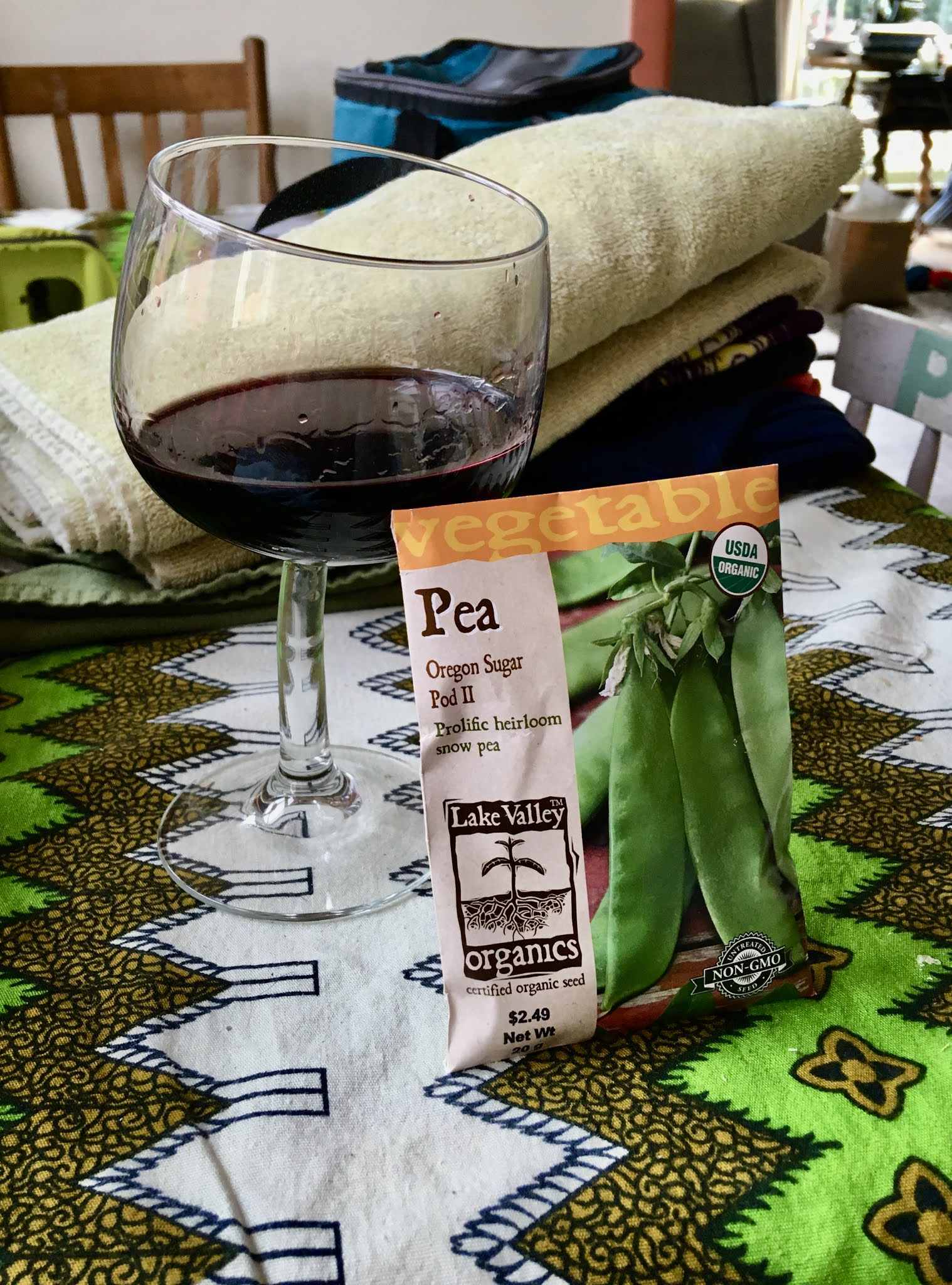
And Pea Planting Day is a special anniversary for us. February 22 is listed on my planting calendar as the first day to plant peas in the Willamette Valley; it also happens that this is the day W and I got engaged to each other, 47 years ago!

Peas are traditionally the first vegetable sown outside in the spring because they will germinate and grow in very cool soil. We plant peas today to ceremonially kick off the start of the planting season, and also to remind ourselves of the beginnings of our relationship; the day we decided to be together forever.

Agenda:
1. Read Nature Mentor
2. Resilience practice
3. Begin plastic fasting
4. Hang up the Lent Lady
5. Pea planting ceremony
6. Permaculture pea tips
7. Make a pea label

December 28, 2022

4th Day of Christmas

This is the fourth day of 
the twelve-day festal tide - a sacred, festive season. My retreat today will again embrace the disposition of a pre-schooler ... a busy kind of retreat, with lots of short projects and (hopefully) a long nap!

Agenda:
1. Christmas retreat
2. Kwanzaa principles
3. Earth care reading
4. Service and activism goals for 2023
5. Prayer candle ceremony
6. Make end-of-year donations
7. Winter nature table

December 2, 2022

A Natural Christmas

My theme for this week of Advent has been "cherish and care for the earth". Each year, this first week, I bring nature indoors, by collecting greens, pine cones, straw, and other natural materials to use for decorations, and for making gifts.
I've been collecting fallen branches of evergreens for the last weeks, and now I will bring them inside to deck my halls. Greens are the first decorations I put up around the house, along with a few candles, to open the door to a little light, and to connect with the earth. Evergreens are a symbol of eternal life, and also symbolic protection against trouble. Today I bring the protective spirit of nature inside.

Agenda:
1. Make scented pine cones
2. Grapevine heart wreath