My main focus in January is to plan the next season's garden, and take care of the nature that continues to live here. The best tip I've read in any permaculture blog is: Be consistent with 15-minutes a day, year round. We've had a streak of amazing, dry weather, so I've got no excuse not to take a short daily tour of my garden - I alternate the front and back gardens so I don't feel rushed. The consistency of the 15-minute daily visit keeps me connected to my garden even when I don't accomplish much.
Agenda:
1. Read "The Serviceberry"
2. Ongo journal
3. January harvest
4. Garden plans
5. January tasks
6. Prepare a worm bin
7. Days of Passion
1. Read "The Serviceberry":

Today I'm reading from "The Serviceberry", by Robin Wall Kimmerer (2024). I got this sweet little book for Christmas in 2024, and have been really taking it slow.
In December I read about the serviceberry tree's system of redistribution of wealth that aids the community of bees and birds. "The relationships created by the gift weave myriad relationships between insects and microbes and root systems."
She goes on to talk about capitalism: "We often lay the blame for the outcome of cutthroat capitalism on the 'System.' ... Let's remember that the 'System' is led by individuals, by a relatively small number of people, who have names, with more money than God and certainly less compassion. They sit in boardrooms deciding to exploit fossil fuels for shot-term gain while the world burns. They know the science, they know the consequences, but they proceed with ecocidal business as usual and do it anyway."
2. Ongo Journal:
.jpeg) I'm going back through this book by Catherine Madden and Jesse Weiss Chu (2022), focussing on the solo practices. The solo practices are meant to be done 5 days a week - 3 practices alternating with 2 "Rememberings", to allow you to go deep.
I'm going back through this book by Catherine Madden and Jesse Weiss Chu (2022), focussing on the solo practices. The solo practices are meant to be done 5 days a week - 3 practices alternating with 2 "Rememberings", to allow you to go deep.Day 5 this week is Being Needs, rather than to have them or to get them met. "Needs are like notes on a scale. ... Through listening to each notes sound and how it resonates through our whole being, we are becoming more intimate with those aspects of our life."
I decided to continue to work with the Need of Effectiveness, which I identified this week as one that brings a weight to my shoulders. The practice today:
- Say the need word a few times, breathing and giving open-hearted space between each repetition. Notice where I feel the energy of that Need in my body, and what kinds of sensations I feel.
- Breathe and allow those feelings to expand throughout my whole body. (I can also visualize an actual or imagined experience of Being this Need.) What does the need feel like when it is deeply satisfied?
- Take a moment to savor this living, breathing experience of the energy of Being this Need.
Journal: Being truly effective feels powerful.
3. January Harvest: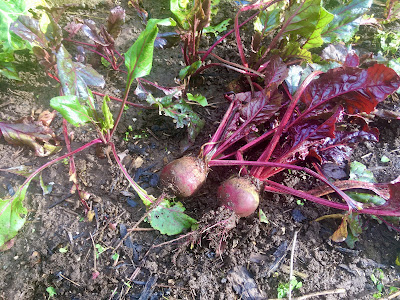
Amy of Ten Acre Farm says, always harvest first, because the goal of all of this gardening is to harvest fresh, healthy food for your table. So, to make sure that happens, prioritize harvesting over other tasks. I plan to harvest another few beets and some parsley today.
4. Garden plans:
I am beginning the fun work of planning my garden. My tasks today are to:
- Choose what to plant: First I'll make a list of what we like to eat, all the standards, plus a few experimental crops.
- Map out the garden: Revise the rotation of my vegetable beds for the year, and figure out where to plant each thing.
My list of garden tasks in January:
 Continue to care for my ducks - cleaning the coop a little more often to keep it dry.
- Continue to feed the birds, and keep the feeders clean.
- Clean my tools and oil them (if I haven't already).
- Prune the grape, and save the vines.
- Dig up some raspberries to thin plants to 2-feet apart.
- Prepare the new pea bed on a dry day- Loosen the soil, spread some leaf mulch, and set up the pea tepee.
- Repair or replace boards around some beds.
- Make a new worm bin!!!

6. Prepare a worm farm:
- Collect two plastic bins that are broad but shallow (since worms, particularly red wigglers, love to live on the top 3 inches of the worm bed), and black or solid-colored. The top bin is where you put your bedding and food scraps, and the bottom bin is for drainage so moisture levels in the worm bin can be maintained. (The second option is to use only one bin but place it on top of a few bricks or pieces of wood. This drains the excess liquid so your worm bin does not become too wet.)
- Drill Holes in the top bin - about 10 holes on the bottom (for drainage) and a few more smaller holes on the bin’s sides near the top (for ventilation).
- Fill the bin about half full with newspaper shreds, dried leaves, coconut coir, and soil. Finally, spray or sprinkle some water on the bedding, it should only be the consistency of a wrung out sponge. To test out the moisture level, take a handful of the bedding and squeeze it, only droplets should come out.
- Then, mix your organic scraps (like fruit and vegetable peels, crushed eggshells, coffee grounds, yard wastes, and so on) with some soil, and add to the top. Make sure you have a regular feeding schedule, maintain both moisture and pH levels for a healthy environment, and you’re good to go!
7. Days of Passion:
On Fridays I make a plan for Nature-Culture flow and writing through the next week. My Nature-Culture theme this month is winter regeneration and awareness. Today I am brainstorming topics in my Winter chapters, and also some garden, advocacy, and community tasks to support that work:- Awareness: Winter awareness retreat at home; Monitor Your Air Quality; Winter temperature awareness; Study soil health
- Design a winter nature awareness retreat, with some ceremony, drawing, and awareness of temperature changes.
- Sanctuary: Start vermicomposting with your kitchen scraps; Plan out your crop rotation
- Start a worm bin!
- Natural living: Air pollution solutions
- Recycled plastic bags crochet;
- Give Back: Advocate for clean air and a safe climate
- Read up on the Clean Water bill, and legislative short session, Research and plan postcards to legislators;
- Send EC News; schedule a sign-making day for next rally - 2-16.


No comments:
Post a Comment