 Hina Matsuri is a Japanese festival that falls every year on March 3. It began in ancient times as a Shinto effigy ceremony to prepare farmers for the planting of spring crops: They would rub their negative energy off onto a doll, then float it down the river.
Today girl's set up displays of dolls, have a tea party, and - yes - some people still send dolls down the river.
The full moon of March is the atcha-uyu or "Women Dig Camus" moon by the Kalapuya of my area, and the Egg Moon by others, because this is the month when birds begin to lay eggs again. The egg is a powerful symbol of hope, new beginnings, and completeness: My vague ideas take a solid shape, enclosed in a perfect shell, and I have created a whole new beautiful thing! The March Full Moon is a good time to ponder the wholeness of life.
We are now at the peak of the high-energy yang phase of the waxing moon, and will soon begin the low-energy yin time of the waning moon.

Agenda:
1. Take a vision walk
2. Celebrate strength
3. Synergy and hope plans
4. Make hina dolls and paper boats
5. The hina-okuri ceremony
6. Prepare to plant
7. Make hishi mochi and have a tea party8. Plan a sabzeh
1. Take a vision walk:
The full moon shines a bright light on everything, and I might experience intuitive and creative breakthroughs. I might be shocked by the clarity of my insights. I might see some ugliness - the full moon illuminates all the things I've left in the shadows, some heavy truths and some embarrassing mistakes.
The full moon shines a bright light on everything, and I might experience intuitive and creative breakthroughs. I might be shocked by the clarity of my insights. I might see some ugliness - the full moon illuminates all the things I've left in the shadows, some heavy truths and some embarrassing mistakes.
Today I call on the Spirit of Light to guide me, bring me clarity and open my eyes. What is the Truth that is coming into focus for me now?
How do I find and maintain a strength of purpose? How does intentionality and meaning help me with resilience? When have I approached unexpected storms with curiosity and vigor, and what was that experience like?How am I being shaken into creative action?What role does optimism and hope play in strength and wholeness?How do I open to the ambiguity of life, so I can bend rather than break?
2. Celebrate strength:
My theme this month has been strength and resilience. I've been Being in Nature, working on purpose and improving my vigor, and making creative shifts in awareness.
Today I will remind myself of my intentions,
celebrate my accomplishments, and reaffirm this theme for the next two weeks.
Each month I choose a different way to celebrate the full moon, and today I am ready to celebrate my strengths in three ways:1. Write about Spring and resilience
2. Go on a vigorous walk with my grandson.
3. Make a hina doll for myself, to transform my luck.
3. Synergy and hope plans:
Every Tuesday I make a plan for teamwork and synergy, important components for effective action. Specifically, I make a list of tiny ways to engage my family and community in my Nature-Culture work. My ideas:
- Signs of spring walks with grandsons
- Purification ceremony with family (dolls)
- Finish Watershed poster and send it out
- Plan regenerative basics for potting Day
- Make a list of plants I have to share with Meeting and neighbors, and their properties.
4. Make Hina Dolls and paper boats:

In the days leading up to Hina Matsuri, children display a collection of dolls, including the emperor and empress dolls, with many attendants. These hina dolls are often very elaborate, but children also make simple dolls, using origami paper for beautiful kimonos.
Hina dolls are effigies, like the Maslenitsa doll - People in many cultures make effigy dolls in the spring to symbolically absorbs all bad luck and negative energy.
 This year I'll make simpler dolls on strips of paper.
I also made a aper boat to carry our dolls away, following the instructions at the Adventures of Captain Crafty site (which is now defunct).
Supplies: Large square of freezer paper, permanent markers, a wooden skewer
1- Cut a large square of freezer paper. Decorate the waxed side with permanent pens.
2- Fold as the diagram shows, with waxed side up.
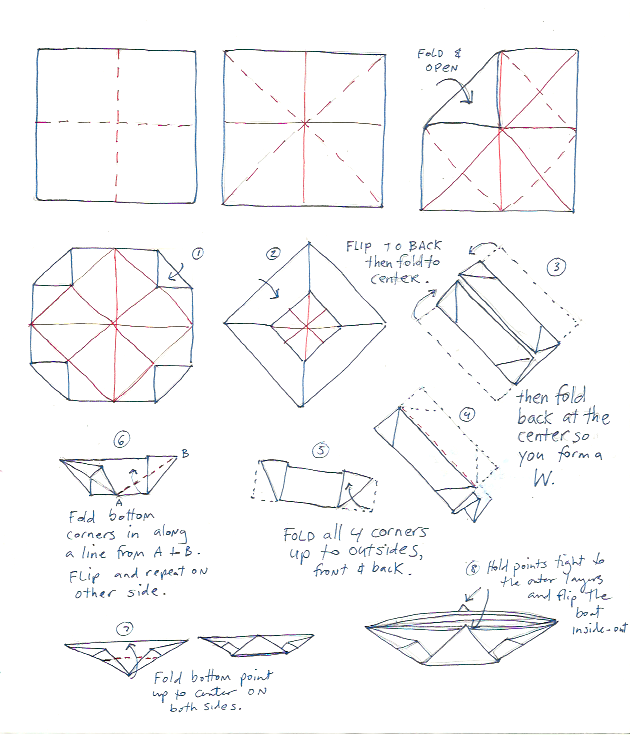
 3- Later we poked a skewer through the boats to hold the dolls in place.
5. The Hina-okuri ceremony:
Late in the afternoon some Japanese families perform the purification custom called hina-okuri: By stroking or breathing on the dolls they symbolically inject them with their own wrongdoings or ills, then they pile their dolls in a small wooden boat, and float them down the river! The river ritually bathes the dolls, and purifies the souls of the doll's owners.
 As with any form of Shinto worship we begin with ritual washing, pouring water over our hands.
The second step is an offering to the kami. In this case, we are offering a paper doll. We each write down what we want to release on the paper inside our hina dolls.
 Next we offer a silent prayer to the kami, of thanksgiving and petition for the future.
Finally, we send the dolls away: We take them to the creek and throw them into the current!
Hina dolls are effigies, like the Maslenitsa doll - People in many cultures make effigy dolls in the spring to symbolically absorbs all bad luck and negative energy.
I used to make hina dolls with my art class students each year. We usually made two dolls each - one to keep and one to float down river. The instructions are here.

 |
| Decorating the boat |
Supplies: Large square of freezer paper, permanent markers, a wooden skewer
1- Cut a large square of freezer paper. Decorate the waxed side with permanent pens.
2- Fold as the diagram shows, with waxed side up.
5. The Hina-okuri ceremony:
Late in the afternoon some Japanese families perform the purification custom called hina-okuri: By stroking or breathing on the dolls they symbolically inject them with their own wrongdoings or ills, then they pile their dolls in a small wooden boat, and float them down the river! The river ritually bathes the dolls, and purifies the souls of the doll's owners.
 As with any form of Shinto worship we begin with ritual washing, pouring water over our hands.
The second step is an offering to the kami. In this case, we are offering a paper doll. We each write down what we want to release on the paper inside our hina dolls.
Next we each take the doll in our hands, close our eyes, concentrate on those issues we are releasing, breathe on the doll, and wish that energy onto it.
Next we offer a silent prayer to the kami, of thanksgiving and petition for the future.Finally, we send the dolls away: We take them to the creek and throw them into the current!
Today I will seek to become aware of a connection to the nature spirits - the kami - or that of God in all of nature, and offer my prayers of hope.
6. Prepare to plant:
Remember - the root purpose of Hina Matsuri is to prepare ourselves for spring planting. March is when the gardening season increases in intensity. I will prepare my garden beds, and plant seeds indoors and out. Right now, it's still too cold to plant outside, but I have lots of bed preparation work to do!
Usually (in my valley) March 3rd is not too early to prepare a bed to plant early greens and onions. If the soil is too wet, prepping beds will damage the soil structure, so I wait until we've had several dry days in a row:
- Chop and drop any leftover cover-crop and let it sit for a week or so to break down.
- Refill raised bed boxes if they are looking empty (organic matter decomposes, so it needs to be replaced every year in the fall or spring. Fill with a blend of sand/silt/clay and compost. If you have in-ground beds (i.e. a lot of clay), a top dressing of compost will help to dry things out and add organic matter to your soil.
- At this time also add any organic nitrogen amendments, such as feather meal (12-0-0), or a well balanced fertilizer (4-4-4), and lightly rake into the soil. I use Down to Earth Organics because they are reasonably priced, organic, and produced locally in Eugene, Oregon.
- Stab and wiggle with a digging fork: Spear the ground then wiggle the fork in all directions and gently lift the soil. This loosens and aerates the soil without destroying the structure, and also gently blends any new soil to avoid creating a separate soil horizon.
- Lightly work the top inch or so of soil with a scuffle hoe.
- Leave soil exposed for now. This will help the soil to dry out and warm up to at least 40 degrees for cool tolerant crops and 50+ for warm season crops.
7. Make Hishi Mochi and have a tea party:
 In Japan, children often share a tea party with friends on Hina Matsuri, with sweet sticky hishi mochi (HEE-she MO-chee), with pink, white, and green layers. White is for purification, green stands for health, and pink will chase away evil spirits. The recipe is here.
 In Japan, children often share a tea party with friends on Hina Matsuri, with sweet sticky hishi mochi (HEE-she MO-chee), with pink, white, and green layers. White is for purification, green stands for health, and pink will chase away evil spirits. The recipe is here.
Make a ceremonial pot of tea to celebrate your new life. Set a nice table, with a flower; put on some Japanese music; choose a beautiful bowl to drink from; make and drink the tea with attention to every scent and taste.
8. Plant a sabzeh:

The sabzeh is a bowl of sprouted grains, a symbol of new life. Since it takes two weeks to get good looking sprouts, we usually start them about now.

Fill the bowl with damp soil, cover the surface well with seeds, and spray daily with water.


No comments:
Post a Comment