
The Winternights, or Vetrnætr, is a twelve-day festival that begins on a night in mid-October, and marks the end of summer and the start of the winter. The name Vetrnætr (pronounced Vetter-natter) is Old Norse, vetr - meaning winter, and nætr - meaning nights. Vetrnætr is series of feasts and ceremonies (blóts, pronounced bloots) that celebrate the bounty of the harvest, and also honor the Disir, or female ancestor spirits.
Vetrnætr is celebrated by the Ásatrú; Ásatrú is an Icelandic name, taken by the modern-day Norse and Germanic people who worship the old northern gods (such as Thor, Odin, and Frey) and goddesses (such as Freya and Frigg). Though its practice was interrupted, Ásatrú has been reconstructed as closely as possible to the original religion of the Northern European people, based on the surviving historical records. Ásatrú intrigues me, because it would have been the religion of my ancestors. This month, Winternights festivals are still held across Scandinavia, Germany, and New England and are marked by bonfires, tournaments, feasts, and arts and crafts vendors.
Today is my sabbath - when I step out of the fray and regroup.I had a busy week and today I will go to Meeting and settle in to my community, in my roll as clerk, to listen and hold the Light. This morning I want to take time to prepare myself - body, mind, and spirit. I want to open to awareness, wisdom, and courage.
 |
| 2022 ofrenda |
1. Read "Your Heart Was Made for This"
2. Letting-go habit
3. Spiritual growth plan
3. Set up my ancestor altar (ofrenda)

Plan this week:
5. Disir meditation:
 As I said, Vetrnætr is series of feasts and ceremonies that celebrate the bounty of the harvest, and also honor the Disir, or female ancestor spirits. Sometime around now, the Norse tribes held a dísablót (sacrifice to the Disir), but the Anglo-Saxons honored the Disir later, on Mother’s Night”, which takes place in late December.
4. Disir meditation
5. Make more runes
5. Make more runes
6. Feast and blót
1. Read "Your Heart Was Made for This":
I'm reading this book by Oren Jay Sofer (2023), with the subtitle, "Contemplative Practices for Meeting a World in Crisis with Courage, Integrity, and Love". It has 26 short chapters on innate qualities we each have, that we can cultivate and develop as inner and external expression, meant to be read and practiced in order, one every 1-2 weeks.
I'm on to Chapter 9, Renunciation. about letting go. Renunciation is an inner resource of simplicity, restraint, and freedom from craving and addiction. It can help me to clarify my priorities, slow down, engage with challenges, adapt to crisis, and honor the natural limits of our planet. Its aim is fulfillment, not deprivation. "When we long for what we don't have, we overlook what we do have and rob ourselves of contentment."
I want to learn the skill of renunciation - by leaning in to the discomforts of my desires without acting on them, being steady and strong, and watching them fade. This is difficult work, so take it one little thing at a time, and ALLOW letting go rather than forcing or denying myself.
Renunciation opens my mind to a wider perspective, and creates the possibility of holding multiple or even conflicting perspectives at the same time.
2. Letting-go habit:
Renunciation is my work this fall: It helps with my home projects, my earthcare focus, and with anger and distraction. I want to frame it as release, simplicity, and fulfillment.
Last week I decided what I want to release:
- Anger / need to control people and chaos
- Need for constant reassurance and praise
- Over-spending
- Sweets
- Papers, notebooks, and other stuff
- Self-criticism
I know I can never fully have freedom from any of these cravings, but I can release them in-the-moment by standing "in the flood of sense desire, feel its pressure, and resist the urgency to act on it."
I've been working on letting go of harsh outbursts and control of chaos by being steady and strong, noticing my discomfort and watching it fade. I've also been working on my over-spending. And my accumulation of stuff.
This is difficult work, so take it one little thing at a time, and ALLOW letting go rather than forcing or denying myself.
3. Spiritual growth goals:
Spiritual growth is the basis for a better and more harmonious life, a life of calmness, courage, and inner strength. My goals for spiritual growth change and flow with the season. And I need to develop practices that help me grow.
I ask, "What is keeping me from living fully for Love and for the earth? What spiritual discipline might help me to find greater Light?"
This month I set the intention to practice a simpler daily flow, settle into intentional time, live with immediacy, intuition, flexibility - and love life as it is, because the Authentic Me needs to balance the Integrity of Doing with the Truth of Being, or the stress will create outbursts.
- Continue to practice my morning and afternoon flow plans, moving through tasks with focus and flexibility.
- Continue my anger and calm journal with particular curiosity about my need to control chaos.
- Plan four separate times to tune-in with the boys - a nature walk, drawing meditation, craft project, and lego play.
4. Set up my ancestor altar (ofrenda):
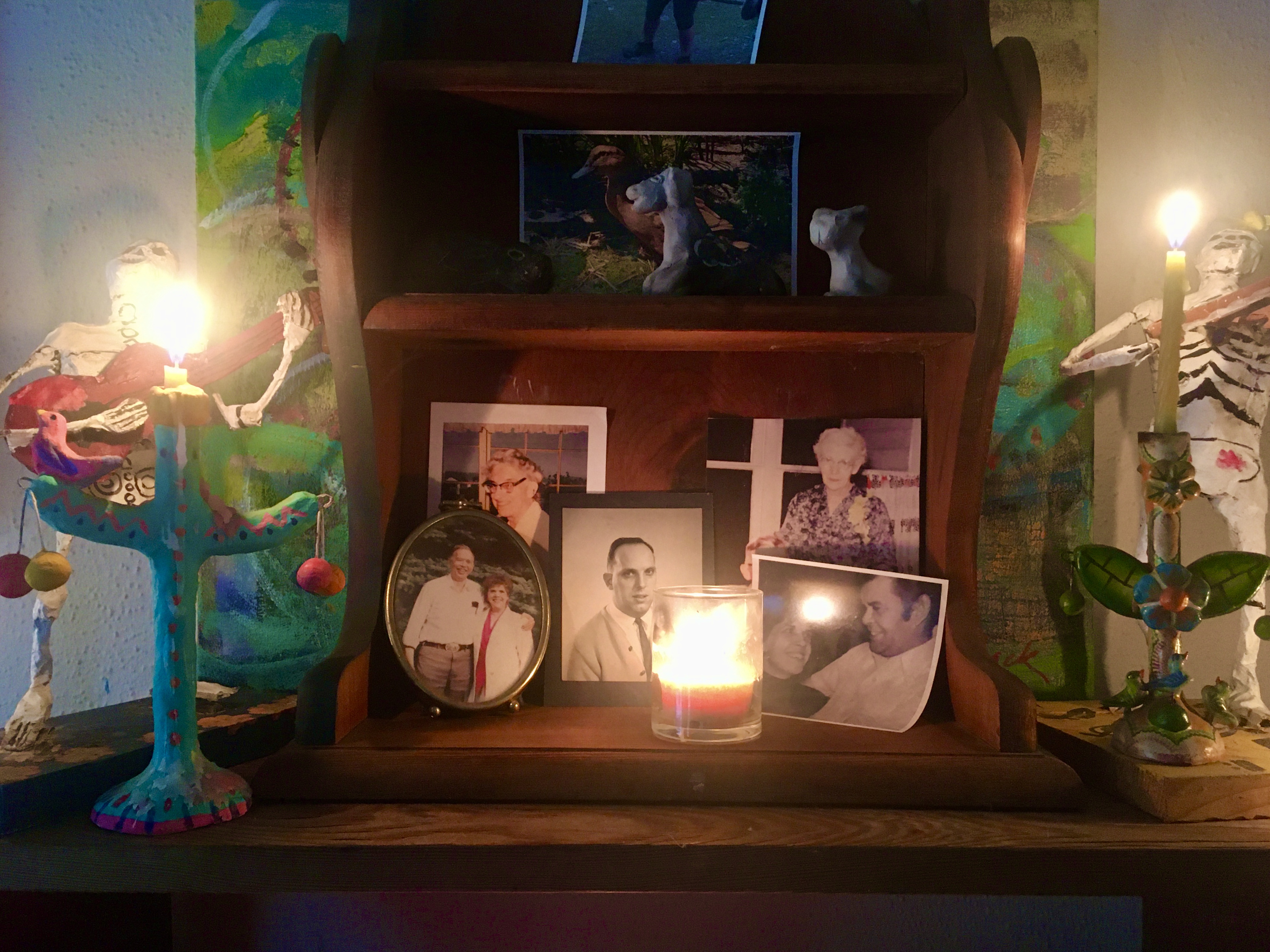
The veil between my world and the spirit world becomes thinner at the start of the winter season. Since Vetrnætr is a time to honor my ancestors, this is when I begin to set up my ofrenda, or ancestor altar.
An ofrenda is a special table for the Mexican Days of the Dead that holds offerings and decorations, such as arches, candles, incense, skeleton toys, marigolds, photographs, sugar skulls, as well as some of the ancestor’s favorite foods and things, and little gifts. I've been collecting and making things for my ofrenda for years. Today I will arrange:
- skeletons, to remind me that death is a part of life
- tree of life candles, symbolic of the creation
- photos of my grandparents, father, my in-laws, and dear friends.
5. Disir meditation:
 As I said, Vetrnætr is series of feasts and ceremonies that celebrate the bounty of the harvest, and also honor the Disir, or female ancestor spirits. Sometime around now, the Norse tribes held a dísablót (sacrifice to the Disir), but the Anglo-Saxons honored the Disir later, on Mother’s Night”, which takes place in late December.
The female spirits known as the Disir (pronounced DEE-sir) are an enigmatic group of beings in the mythology and religion of the pre-Christian Norse and other Germanic peoples. The Disir are my female ancestors - grandmother spirits and guardians of the household. They have special knowledge in matters of family luck, illness, childbirth, personal problems, and other everyday matters.
Today I will hold a personal dísablót - I will light a candle on my ofrenda and settle into meditation. I'll bring a picture into my mind of my grandmothers - those strong German, Dutch, and Anglo women who traveled across the ocean and the frontier. I read their names out loud, and picture them gathering around me. I ask my grandmothers to make themselves known to me and stand by me during the coming year, that I may face the demands of the world with the wisdom of my kin at my back.
 Runes are an ancient writing system created about 100 - 200 AD by Germanic tribes and spread all over middle and northern Europe by the migration of these tribes. The runes were used by the Germans, the Scandinavians, the Angles and Saxons. They are found inscribed onto stone, bone, and metal, and were used for poems and ornamentation, as well as divination.
6. Make more runes:

I've been working on a set of runes, burned onto circles cut from a hazel branch, and today I will make a new one.
7. Feast and blót:
The blót ceremony, which means “to worship with sacrifice,” comes after a feast. The purpose of the blót is to thank the gods for a successful end to the growing season, to share the bounty with the gods, and to ask for protection against the harshness of winter. The old prayer was til árs ok friðar, “for a good year and frith (peace)”.


No comments:
Post a Comment