October 19, 2015

Navratri, Part 3

Navratri is a Hindu holiday during which we honor and thank Shakti, the Divine Mother, in all her forms. Shakti is the universal principle of energy and creativity, Mother Earth, and the feminine power in each of us. The word nava means nine and ratri means nights; the festival lasts for nine nights, which are broken up into sets of three, and during each a different aspect of Shakti is meditated upon. This is the final three nights.

Agenda Today:
1- Add to my altar:

For the next three nights the Mother is invoked as Saraswati, the Goddess of learning, wisdom, speech, music, and all the creative artsSaraswati means "the essence of self". Hindus often put books and art tools on the puja so that Saraswati can bless them.

Today I added two of my favorite books of wisdom, and my jar full of paint brushes, to rededicate myself to the search for Truth and Inspiration.

2- Meditation:
During Navratri, Hindus work on their vyavhaar (behaviour) and acharan (character). Each of the three goddesses signifies a stage of the spiritual journey we all go through: Durga’s strength and energy creates an opening, Lakshmi’s success and fortune nurtures growth, and Saraswati’s wisdom and knowledge leads to enlightenment, happiness, and peace.

On my path I pass through the stages that everyone has to pass through- one naturally leads to the next. As I eliminate an undesirable quality, I develop the virtue opposite to it. Each time I succeed in developing and strengthening my good qualities, I am ready to receive another bit of the Light, moving towards enlightenment- that is what the nine days of Navratri are all about.

On each morning of Navratri I light a small white candle, center, and feel myself fill with thankfulness for all I have now in my life. For these next three mornings I meditate on my inner wisdom, and the new light and understanding I have received this season.

3- Make sundal: 
Many Hindus eat only vegetarian foods during Navratri; often a different sundal (dry legume dish) each night. 

Served with homemade naan and green beans.


Ingredients: 
  • 1 c. moong dal (yellow lentils) 
  • 1/2 tsp. turmeric powder 
  • salt to taste 
  • 4 tsp. oil 
  • 1/2 tsp. mustard seeds 
  • 1 - 2 green chili peppers
  • 1 tsp. fresh gingerroot
  • 1/2 tsp. of lemon juice 
  • 1/4 c. coconut
Yield: 4 servings-

1- Combine the moong dal, 3 c. water, turmeric, and salt in a heavy bottomed pan. Simmer on medium for 10 - 12 minutes, stirring frequently. Do not over cook- the moong dal should be soft, but still whole and not mushy. Drain and set aside.

2- Meanwhile, chop the green chili and mince the ginger.

3- Heat oil in a wok or frying pan, add mustard seeds, chili, and ginger. Stir and fry for a couple of minutes, then add the drained moong dal and saute for a minute.


4- Add grated coconut and lemon juice. Mix well. Serve hot.

4- Visualization and prayer:
I end each day of Navratri with a prayer. For these last three nights I honor the intuitive aspect of the Mother.

Saraswati is dressed in white, holds a scroll and plays music on a veena. She is called the Flowing-One because she comes from the river, and offers the gift of fluidity in speech and thought. She is the embodiment of the knowledge of Truth and spiritual wisdom. Saraswati shines with the pure light and uplifting energy of sattwa.

I picture this Mother spirit sitting on the blossom of my heart, sprinkling me with cleansing waters, and shining the light of wisdom, peace, and Truth.

“Thank you, Great Spirit, for providing energy for the earth to move around the sun, and for maintaining the correct balance of the universe. You are the earth. You nourish support, protect, and mother all creatures, all beings. I ask you to help me to develop and maintain patience, forgiveness, compassion, loving-kindness, and integrity, and guide my voice to speak the Truth." 

6- Saraswati Mantra:
I focus on my image of Saraswati and chant- 

  • Om - the primodial sound 
  • Aim - from which knowledge and powers of speech emanate 
  • Sa-ra-swath-yai - goddess of wisdom 
  • Na-ma-ha - I pray.
(You might want to chant along with someone who knows how. Many YouTube versions exist, and my favorite is here.)

October 16, 2015

Navratri Continues

Navratri is a Hindu holiday during which we honor and thank Shakti, the Divine Mother, in all her forms. Shakti is the universal principle of energy and creativity, Mother Earth, and the feminine power in each of us. The word nava means nine and ratri means nights; the festival lasts for nine nights which are broken up into sets of three, and during each set a different aspect of Shakti is meditated upon. This is the second set, when Lakshmi visits.


Agenda Today:
1- 
Rangoli:
Today I made a rangoli of Lakshmi's footprints on the threshold of our front door, with chalk and rice flour, to welcome the Goddess of success.

2- Add to my altar:
For the next three nights the Mother is invoked as Lakshmi, goddess of material and spiritual wealth.

I added a bowl of coins from around the world, for the nurturing quality of the Shakti. (Notice that the seeds have sprouted!)

3- Meditation:
During Navratri, Hindus work on their vyavhaar (behaviour) and acharan (character). Each of the three goddesses signifies a stage of the spiritual journey we all go through: Durga’s strength and energy creates an opening, Lakshmi’s success and fortune nurtures growth, and Saraswati’s wisdom and knowledge leads to enlightenment, happiness, and peace.

The word Lakshmi comes from the Sanskrit word Laksya, meaning aim or goal. After Durga has destroyed the old structure of my personality, a constructive process can begin. Lakshmi heals and nourishes my spirit and brings me steadiness of mind. She bestows spiritual and material wealth, good food, health, and happiness. 

On each morning of Navratri I light a small white candle, center, and feel myself fill with thankfulness for all I have now in my life. For these next three mornings I meditate on my inner life-giving force of creativity, and the qualities and habits I wish to cultivate in the days ahead.

4- Make sundal: 
Many Hindus eat only vegetarian foods during Navratri; often a different sundal (dry legume dish) each night. 

Tonight I plan to make Sweet Corn Sundal.

Ingredients:

  • 2 c. frozen sweet corn
  • 1-2 green chilies
  • 1 small carrot
  • 2 Tbsp. oil
  • 1/2 tsp. mustard seeds
  • 1/4 c. grated coconut
  • salt to taste

1- Steam the corn in water according to the package instructions, then drain and set aside.

2- Finely chop chilies and carrot.

3- Heat oil in a wok or frying pan; add mustard seeds and stir until they start to pop, then add chilies and carrots and sauté for a minute.
4- Add the cooked corn, salt to taste, and coconut. Stir and sauté for 2 minutes until all is combined. Serve hot or warm.

5- Visualization and prayer:
I end each day of Navratri with a prayer. For these next three nights I honor the constructive aspect of the Mother. 

Laksmi is a beautiful golden woman with four arms, sitting on a fully bloomed lotus and holding a lotus bud. Cascades of gold coins flow from her hands, and she wears gold embroidered red clothes, indicating her offering of prosperity. Lakshmi brings the growth and unfolding of whatever is life-enhancing. 

I picture this Mother spirit sitting on the blossom of my heart, gently opening it to accept love and happiness into my life.

“Thank you, Great Spirit, for providing energy for the earth to move around the sun, and for maintaining the correct balance of the universe. You are the earth. You nourish support, protect, and mother all creatures, all beings. I ask you to help me to develop and maintain patience, forgiveness, compassion, loving-kindness, and integrity. Give me the persistence to succeed at my goals, and bless me with abundant health and happiness.

6- Lakshmi Mantra:
I continue to focus on my image of Lakshmi and chant-
  • Om - the primodial sound 
  • Shreem -  from which beauty and feminine energy eminates
  • Ma-ha - great
  • Lak-shma-yai - goddess of wealth
  • Na-ma-ha - I pray.

(You might want to chant along with someone who knows how. Many YouTube versions exist, and my favorite is here.)

October 14, 2015

Al-Higra

Al-Higra begins tonight at sunset, when the crescent moon is sighted. Higra means migration, and also an escape from a dangerous situation. The original higra was the journey of the Prophet Muhammad from Mecca to Medina in 622 CE, after he learned that another Arab tribe was trying to assassinate him. This date became the Muslim New Year, on the 1st day of the month of Muharram.
Photo by Alan Gilespie.

Today Al-Higra is celebrated quietly, with prayers, readings, and reflection, not the hoopla we associate with the New Year. Muslims tell the story of Muhammad’s flight through the desert on camel-back with sword-wielding thugs in pursuit. They reflect on their own migrations, actual or of the soul. Because higra means moving from a bad state of affairs to a good one, many Muslims use this time to think about resolutions for the New Year.

Agenda Today:
1. Journal:
I sometimes find it a stretch to relate personally to Muslim holy days because they are not seasonal- they shift every year- and I am a seasonal kind of girl. This year Al-Higra comes at a good time for me, as my life is in transition. Also I am currently working through the cycle of Navratri, which is all about transition.

Today I consider:
If I am on the path to a new life-
  What resources do I need for the journey? 
  How can I better enjoy the journey?
  How will I know when I have arrived at my destination?

From my journal: Aren't I always, everyday, on a path to a new life? That is just how life goes. Right now I have greater uncertainty, and a feeling of turmoil, but really I have all the "gear" I need for this trip: I have my integrity, my good heart, my family and community, my experience.

2. Read the story of the Higra:
I watched this fun school play enactment on YouTube.

3. Prayer:
It would be pointless for me to try to pray like Muslims do; I would not get it right, and it wouldn’t mean much to me. I do however enjoy praying with sibha beads, a string of 33 beads. And for this first week of Muharrem, I will use them as I repeat some of the 99 names of Allah:

Ar-Rahman - The All-Merciful
Ar-Rahim - The All-Beneficient
As-Salam - The Source of Peace

Al-Karim - The Generous
An-Nur - The Light


4. See the crescent moon: 
I plan to go out at sunset tonight to view the crescent moon. The crescent with a star is the symbol of Islam; the moon’s rebirth after darkness gives us hope each month.

October 13, 2015

Autumn Navratri and New Chrysanthemum Moon

Navratri is a Hindu holiday during which we honor and thank Shakti, the Divine Mother, in all her forms. Shakti is the universal principle of energy and creativity, Mother Earth, and the feminine power in each of us. The word nava means nine and ratri means nights; the festival lasts for nine nights, symbolic of the nine months in the womb.

Navratri is celebrated at least twice each year in India, in the spring and fall, because these are times when nature and people undergo great changes. Autumn (Sharad) Navratri begins on the day of the new moon in late September or early October.

The Chinese call this ninth new moon the Chrysanthemum Moon. The chrysanthemum is a symbol of long life and endurance because of its ability to withstand colder temperatures. According to Chinese scholars, it shows the virtues of one who can endure temptations and maintain grace.

Agenda Today:
1- Paint Chrysanthemums:
I bought a chrysanthemum to plant in the pot on the porch, and yesterday I took some time to practice my Chinese brush painting, thinking on the qualities of endurance and grace.


I got excited, and attached the rice paper to a small canvas, and proceeded to paint the abstract shown below.
Endurance- acrylic on canvas.


2. Journal:
What are the possibilities?

What might give my life more wholeness?

What would I most like to do in life that I'm not getting to?

List my intentions for the next four weeks in these areas-

Self, Friends and Family, Teaching, Artwork, Writing, Home and Garden, Work/Business, and Volunteer work.


3- Make a rangoli design:
Rangolis are rice flour designs, made on the floor or a metal plate. At Navratri a new design might be made each day, with dots, squares, flowers, birds, and so on- each one designed to welcome the spirit of the Goddess.

Today I made a rangoli on the silver plate that holds my diya lamps, choosing a design that I found at this site

I made my own colored rice flour- for more information about rangoli, and how I made the colored rice flour, see my Pongal post. 


First I used a sieve to sprinkle the pink rice flour evenly onto the plate.


Next I used a stick to trace the design- it's hard to see, but I made dots first to get the right spacing.


4- Plant seeds:
My three cereal, soaking overnight.
Most Hindu households sprout a bowl of seeds for Navratri, called the Nava-Dhanya (nine cereals), each a symbol of a different planet. 

Last night I put three kinds of grain seeds in a bowl of water to soak overnight: Wheat for the sun, rice for the moon, and corn for the earth (corn is not a Hindu grain but important to me!) 
Cereals spread on a layer of damp soil-
next I will cover with another layer of soil. then spray with water.
Today I planted my seeds and watered them well; the sowing, sprouting and growth of the grains is intended to bring peace, abundance, and joy to the household. As they sprout during the nine days of the festival, they will remind me of the vibrancy of life and the creative energy of the Shakti.


5- Set up an altar for Mother Nature:
The nine nights of Navratri are broken up into sets of three, and during each a different aspect of Shakti is meditated upon- the Goddesses Durga, then Lakshmi, and then Saraswati. For the first three nights the Mother is invoked as Durga, goddess of strength and courage.
Durga is on the left, above the bowl of seeds.
Today I made an altar to honor the Mother. My altar is in no way authentically Hindu- I make it for my own use, to remind me of the work I am doing. If you want to see an authentic puja, watch this video.

I set out pictures of the three goddesses and added:
  • my rangoli design- to welcome the Shakti
  • bells- to keep me awake
  • diya lamps- for the Light of God
  • God's eyes- to watch over us
  • my harvest doll- for autumn
  • an empty bowl- to remind me to start each day with no expectations
  • and a bowl of soil with seeds- for the creative energy of the Shakti
6- New Moon Meditation:
During Navratri, Hindus work on their vyavhaar (behaviour) and acharan (character). Each of the three goddesses signifies a stage of the spiritual journey we all go through: Durga’s strength and energy creates an opening, Lakshmi’s success and fortune nurtures growth, and Saraswati’s wisdom and knowledge leads to enlightenment, happiness, and peace.

On each morning of Navratri I light a small white candle, center, and feel myself fill with thankfulness for all I have now in my life. For the first three mornings I meditate on my strengths- the ways that Durga shines in me- and the qualities or habits I wish to let Durga destroy.


7- Make sundal: 
Many Hindus eat only vegetarian foods during Navratri; often a different sundal (dry legume dish) each night. 

Tonight I will make Channa Sundal, with chickpeas- spicy and good!


Ingredients: 
  • 1 can chickpeas
  • 1 Tbsp. oil
  • 1/2 tsp. mustard seeds
  • 1/2 tsp. crushed red pepper
  • salt
  • 1/3 c. grated coconut
  • pinch of cayenne
Yield: Serves 2-

1- Open the can of chickpeas and rinse and drain. Set aside.

2- Add oil to a wok or frying pan and heat. Add the mustard seeds to the hot oil, and stir for a few seconds, just until the seeds begin to pop.

3- 
Add the chickpeas and the red pepper, and mix well. Add a pinch of Asafoetida (helps with gas!), salt to taste, the grated coconut, and a pinch of cayenne. Mix and stir for few seconds then turn off the heat, cover, and let it sit for few seconds. Serve with yogurt and naan.


8- Visualization and prayer:
I end each day with a prayer. For these first three nights I honor the destructive aspect of the Mother. 

Durga is a warrior- not an easy image for a pacifist, but important to acknowledge. Durga rides a fierce tiger, and has 10 arms, which hold weapons and a lotus flower. She destroys  the evils that threaten the stability of the cosmos, and she helps the universe to continue with its cycle of creation, preservation and destruction.

I picture this Mother Spirit entering my heart riding her tiger. I see Her wipe out my anger, greed, laziness, procrastination, indifference, pride, defensiveness, and jealousy.

"Thank you, Great Spirit, for providing energy for the earth to move around the sun, and for maintaining the correct balance of the universe. You are the earth. You nourish support, protect, and mother all creatures, all beings. I ask you to help me recognize those aspects of myself that are not helpful. Give me the strength and courage to maintain my physical and mental balance, and to destroy my vices and defects so that what is good and pure has room to unfold.”

9- Durga Mantra:
I continue to focus on my image of Durga and chant-

  • Om - the primordial sound, 
  • Dum - the energy which protects from all negative influences, 
  • Dur-ga-yei - goddess of strength, 
  • Na-ma-ha - I pray.
(You might want to chant along with someone who knows how. Many YouTube versions exist, and my favorite is here.)

October 12, 2015

Indigenous Peoples Day

Happy Indigenous People's Day! Some people celebrate the second Monday in October as Columbus Day, but some of us prefer to honor instead the people who were here in the Americas for centuries before Columbus "discovered" it. 

Many cities are finally making the name change official, adopting Indigenous People's Day as a day to celebrate the people and their culture, and also to reflect on their ongoing struggles in this land. The celebration includes powwows, drumming, dancing, Native American foods and crafts. 

My art class students learned about native people from all over North and South America. We read books, told stories, cooked foods, and made authentic crafts. We had two goals: To show respect and honor for native people, and to learn something about their traditions.

Agenda:
1. Journal:
Set an intention for the day- 
What do I wish for all people of the world?

2. Make fry bread:
Traditional powwow food!

Ingredients:
  • 1 pkg. yeast 
  • 1/2 tsp. salt 
  • 1-1/2 Tbsp. sugar
  • 1-1/2 Tbsp. oil
  • 4 c. flour
  • 1-1/2 c. vegetable oil for frying
Yield: 8-10 pieces-


1- Dissolve the yeast in 1-2/3 c. warm water for 5 minutes, then add salt, sugar, and oil.


2- Add flour to the liquid mixture 1 cup at a time, mixing with a spoon, until the dough pulls away from the side of the bowl. 

Knead on a floured board, adding more flour as needed, until smooth. Put dough in a greased bowl, cover with a towel and let it rise for 1 hour.


3- Heat oil in a cast iron skillet to 350ºF.


4- Remove dough from the bowl and divide into 8-10 balls. Roll or pat each to 1/2-inch thick circles or squares (or hearts or whatever!)


5- Drop the dough into hot cooking oil 1 or 2 at a time (don't over crowd). Cook for about 1 minute on the first side and less on the second side. Drain on paper towels and sprinkle with cinnamon sugar or powdered sugar-- YUMM.


3. Make a prayer stick:
A prayer stick is a southwest Native American tradition; it’s a stick made as a prayer or wish. Prayer sticks are decorated in many ways- sometimes painted, wrapped with strings, with feathers, beads and other objects attached; sometimes a small bag of sacred cornmeal is tied on.

We each set an intention for our stick- something we wished for all people of the world-- enough food to eat, a home, peace, and love-- and we then we made small charms out of clay, to symbolize our wishes.

I didn't get any good photos of our charms this year after they were painted, but you can see my ear of corn here, on the left.

(Last year's charms are shown here.)

Then we cut sticks from the apple tree and:

-carved them

-wrapped them with string and yarn

-added beads


-and added feathers.


Then we each took our stick home to plant in the ground.

October 1, 2015

Mehregan

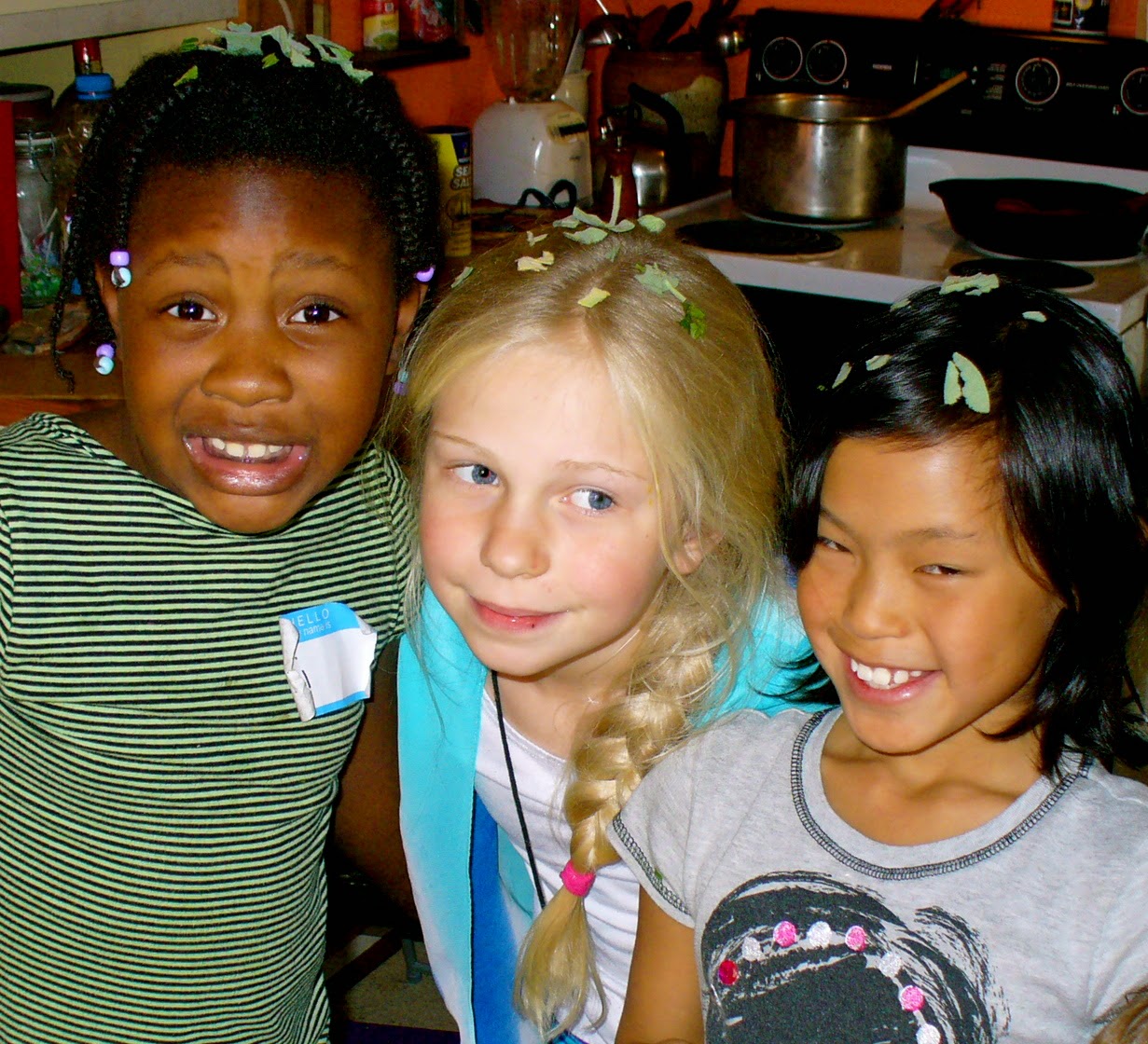
Mehregan 2014: We talked about what friendship means, then
my students had fun sprinkling herbs on each other's heads. 
Mehregan (pronounced ‘meh-re-gahn’), is an ancient Persian festival that began as a feast for the sun god, Mehr. Mehr (also known as Mithra) was responsible for knowledge, love, friendship, promises, and the light. The word "mehr" in Farsi means kindness.

Zoroastrianism took hold in Persia 
in around 1400 BCE and Mehr was reduced from a God to an angel, but the festival of Mehregan remained, and is now celebrated as a day of thanksgiving, usually on October 1st; people decorate their houses, put on new clothes, and visit their relatives and friends, wishing each other a good harvest, long life, and happiness.

Zoroastrians in Iran and India have a community feast today, with a large pot of noodle stew called âsh-e. The stew is always prepared by everyone together because the Avesta (the Zoroastrian holy book) says that each should bring whatever they can afford- meat, vegetables, lentils, grain, or firewood.

I'm not celebrating Mehregan today, but I've reposted last year's post here:

Agenda Today:
1. Journal:

Today I like to focus my thoughts on how well I honor the promises and commitments of friendship.

In what condition are my friendships? How might I be a better friend?

List the friends that I want to nurture and pay special attention to this month, those I feel distant from or whom I want to understand better and appreciate more.

2. Make soup:
Aash-e-Reshte, a delicious, rich noodle soup, is the meal normally served on this occasion. 


Part of the fun when we make this soup is the anticipation- I ask my students to each bring a few of the ingredients, which get taken out of backpacks after school and gathered on the table. 

Each student prepares the foods they contributed- peeling carrots and potatoes, chopping spinach and parsley.


Peeling carrots for the soup.
Ingredients:
  • 1/2-c. dry lentils
  • 1/2-c. pearl barley
  • 1 bunch fresh parsley or cilantro
  • 1 carrot
  • 1 potato
  • 1 tomato
  • salt and pepper
  • 1-lb. fresh spinach
  • 1/2-lb linguine (or persian reshteh noodles)
  • 1 can each garbanzos and red kidney beans
  • 1 medium onion
  • 2 Tbsp. chopped fresh mint
  • 1 tsp. turmeric
  • 1 c. plain yogurt
    (Yield: 8-10 servings)
    1- Pick over and rinse the dried lentils. Cover with 2 c. water and simmer for about 45 minutes, stirring occasionally. Cook the barley in another pot, covered with water, for about 30 minutes.

    2- Meanwhile, clean the parsley and chop finely. Put into a soup pot with 6 c. water. Peel and chop carrot, potato & tomato. Add with salt and pepper. Simmer 20 minutes.

    3- Clean and chop the spinach and add to the soup pot. Break the noodles into 2-inch pieces and add to the pot. Simmer until noodles are cooked.

    4- Slice the onions and fry in a little oil until they turn golden brown. Add the mint and turmeric, stir, and set aside.

    5- When the noodles are cooked, add lentils, beans, barley, and onions to the soup pot; simmer for 10-15 minutes. Taste for seasoning. Place âsh-e in bowls and stir in yogurt.


    3. Ceremony:
    Zoroastrians set a very elaborate table display for this celebration. I don’t even try to duplicate it, but I do try to include these Zoroastrian symbols:
    • Mirror – symbolizing Sky
    • Apple – symbolizing Earth
    • Candles – symbolizing Fire
    • Rose water – symbolizing Water
    • Seeds (such as peas, beans, and lentils) – symbolizing last year's harvest and next year's plan.
    We also set out flowers and incense, all surrounded by branches of herbs from my garden.

    We gathered around the table, lit the candles, and had a moment of silent prayer, to review and rededicate promises we have made to our families and friends. 
    Then we had fun tearing up sage and lavendar leaves to sprinkle on each other’s heads, to wish everyone good health and happy life.


    And then we ate our soup! (We put the pot down for Sadie, because Zoroastrians revere dogs and always make sure they get soup on this day.)